🔑 Passphrases Beat Complex Passwords: Enterprise Is Switching
On this page
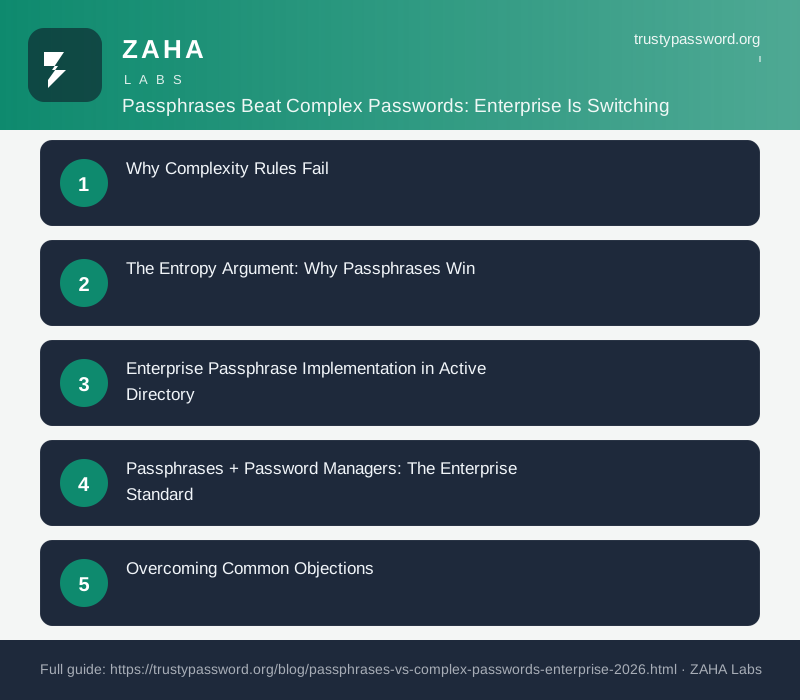
- Why Complexity Rules Fail
- The Entropy Argument: Why Passphrases Win
- Enterprise Passphrase Implementation in Active Directory
- Passphrases + Password Managers: The Enterprise Standard
- Overcoming Common Objections
- The Future: Toward a Passphrase-First Standard
- FAQs
- Getting Started with Enterprise Passphrases
Passphrases—multiple random words combined into a single credential—are systematically replacing complex password rules across enterprise Active Directory environments in 2026. The shift is backed by hard data from the National Institute of Standards and Technology (NIST), the UK's National Cyber Security Centre (NCSC), and real-world breach statistics that show complexity rules produce weaker security, not stronger.
The BleepingComputer analysis published May 27, 2026, highlights a growing consensus: traditional password complexity requirements—mixing uppercase, lowercase, digits, and symbols—are counterproductive. When forced to meet arbitrary complexity rules, users predictably produce password variants like Password!2026 or Winter2026!, which are trivially guessable by modern cracking tools. Passphrases change the equation entirely.
Why Complexity Rules Fail
The Verizon Data Breach Investigations Report 2025 found that 81% of hacking-related breaches involved stolen or weak credentials—not sophisticated zero-day exploits. IBM's 2026 Cost of a Data Breach Report puts the average breach cost at $4.88 million, the highest in the study's 21-year history. These numbers make it clear: the current approach to password policy isn't working.
The core problem is human psychology. When users are required to create passwords with at least one uppercase letter, one number, and one symbol, they reliably follow predictable patterns:
- Capitalise the first letter and add
!at the end - Append the current year or season
- Base the password on a common word or name
- Make minimal incremental changes when forced to rotate
Attackers have built dictionaries specifically targeting these patterns. The Open Web Application Security Project (OWASP) maintains a list of the most common password patterns, and the list is dominated by complexity-satisfying but entropy-deficient credentials.
NIST Special Publication 800-63B, the global standard for authentication security, explicitly moved away from complexity rules in its 2017 revision. Instead, NIST recommends:
- Minimum length of 8 characters, preferably 15 or more
- No arbitrary composition rules (no requirement for mixed case, numbers, or symbols)
- No mandatory periodic password changes unless compromise is suspected
- Breached password checking against known credential databases
The NCSC's 2024 password guidance goes further, describing multi-word passphrases as "the strongest and most memorable approach" for everyday security. The Cybersecurity and Infrastructure Security Agency (CISA) similarly recommends passphrases over complex passwords in its 2025 guidance update.
The Entropy Argument: Why Passphrases Win
The security of any credential depends on its entropy—the number of possible combinations an attacker must exhaust. Each additional bit of entropy doubles the search space.
| Credential Type | Example | Effective Entropy | Crack Time (10B guesses/s) |
|---|---|---|---|
| 8-char complex | P@ssw0rd! |
~18 bits (common pattern) | Milliseconds |
| 10-char complex | Summ3r2026! |
~24 bits (season+year pattern) | Seconds |
| 12-char random | kD3!mP9z$xR2 |
78 bits | ~5 million years |
| 4-word passphrase | correct horse battery staple |
51.7 bits | ~53 days |
| 5-word passphrase | correct horse battery staple tree |
64.6 bits | ~11,000 years |
| 6-word passphrase | correct horse battery staple tree apple |
77.6 bits | ~3 million years |
The critical insight is that a 5-word diceware passphrase provides more entropy than a 14-character random complex password, with vastly better memorability. Users can remember "abacus distant opal jasmine tree" much more reliably than "kD3!mP9z$xR2".
For enterprise environments, this means fewer password reset tickets, fewer sticky notes under keyboards, and genuinely stronger security. The NIST 800-63B recommendation of allowing passwords up to 64 characters directly supports passphrase adoption.
Enterprise Passphrase Implementation in Active Directory
Microsoft's Active Directory has historically been the backbone of enterprise identity management, and its default password policies have contributed to the complexity-first approach. However, organisations implementing passphrase-friendly policies report significant improvements.
Specops Software's analysis, covered in the May 2026 BleepingComputer report, outlines four key strategies for enterprise passphrase adoption:
Length Over Complexity
Instead of requiring one uppercase, one number, and one symbol, set a minimum length of 15-20 characters. This automatically enables passphrases while blocking short complex passwords that users fall back on. The European Union Agency for Cybersecurity (ENISA) supports this approach in its 2025 recommendations.
Breached Password Blocking
Combine passphrase policies with continuous checks against known credential databases. With over 5.4 billion breached credentials catalogued, blocking compromised passwords at creation is far more effective than trying to fix the problem after a breach. The PCI-DSS v4.0 now requires breached password checks as part of its authentication standards.
Extended Password Expiry
When users create longer passphrases, extend or remove mandatory password rotation. The NCSC advises against forced password changes unless there's evidence of compromise—a strong passphrase does not degrade over time, and mandatory rotation encourages the kind of incremental changes that weaken security.
Self-Service Password Reset
Implementing self-service password reset with passphrase-friendly guidelines reduces helpdesk calls while maintaining security. The Cyber Essentials framework from the UK's National Cyber Security Centre includes self-service reset within its recommended controls.
Passphrases + Password Managers: The Enterprise Standard
The combination of passphrase-based master credentials and password manager auto-generation creates the strongest practical security model for enterprise environments.
Users remember one strong passphrase (5-7 diceware words) as their master credential for the password manager vault. The password manager then generates, stores, and auto-fills unique random passwords for every application and service. This eliminates password reuse—the single biggest credential vulnerability in enterprise settings.
For comprehensive endpoint protection that secures both the password manager vault and the systems it protects, Kaspersky Premium includes password audit tools, credential breach monitoring, and enterprise-grade antivirus protection that integrates with existing security stacks.
Enterprise-grade solutions like NordPass, Bitwarden, and 1Password support passphrase generation within their platforms. NordPass offers a zero-knowledge architecture with enterprise SSO integration, making it a strong choice for teams that need both security and ease of deployment. The open-source nature of Bitwarden makes it particularly attractive for security-conscious IT teams that want to audit the encryption implementation. For teams managing shared credentials, enterprise password managers with role-based access control provide additional security layers that consumer products don't offer.
Overcoming Common Objections
"Users won't adopt passphrases"
The experience of organisations that have made the switch contradicts this. When users understand that a passphrase is easier to type and remember than a complex password, adoption is high. The key is communication: explain why passphrases are better and provide clear guidelines. ENISA's 2025 report on user authentication found that intuitive adoptability was one of the strongest predictors of security compliance.
"Legacy systems don't support long passwords"
This is the most significant technical barrier. Some legacy banking and government systems enforce maximum password lengths of 12-16 characters. The solution is a tiered approach: use passphrases for modern systems and password manager-generated complex passwords for legacy constraints. CISA recommends this hybrid model in its Zero Trust Maturity framework.
"Passphrases are harder to type on mobile"
While longer credentials do take more time to enter on mobile keyboards, password managers solve this problem through auto-fill. On modern smartphones, platform password managers (iCloud Keychain, Google Password Manager) and third-party apps fill passphrases automatically. The few times users manually type a passphrase, the trade-off of a few extra seconds versus a potential breach is easily justified.
When accessing corporate resources from public Wi-Fi or mobile networks, even strong passphrases can be vulnerable to man-in-the-middle attacks. Hide My Name VPN provides enterprise-grade encrypted tunnelling that protects credentials in transit across any network, with a strict no-logs policy audited annually.
The Future: Toward a Passphrase-First Standard
The trajectory is clear. NIST removed complexity rules in 2017. The NCSC promoted passphrases in 2024. The PCI-DSS v4.0 incorporated breached password checking in 2025. By 2026, the enterprise security community has largely converged on passphrase-first policies as the pragmatic standard.
The transition won't happen overnight—legacy system constraints, organisational inertia, and user training requirements create real friction. But the data is unambiguous: passphrases reduce breach risk, lower helpdesk costs, and improve user satisfaction compared to traditional complex password rules.
For secure communications where passphrases or credentials are shared with team members, Trekmail offers end-to-end encrypted messaging that ensures sensitive credential information remains private from service providers and intermediaries.
Organisations that adopt passphrase-first policies today will have a significant security advantage as AI-powered password cracking continues to improve. The combination of Turbo VPN's high-speed encrypted browsing, password manager integration, and passphrase-based policies creates a defence-in-depth strategy that addresses credential threats at every layer.
FAQs
What's the minimum passphrase length for enterprise use?
A 5-word diceware passphrase (64.6 bits of entropy) is the minimum recommended for enterprise environments. For privileged accounts (domain admins, service accounts), 6-7 words provide a greater security margin. NIST recommends allowing passwords up to 64 characters, which easily accommodates 5-7 word passphrases.
Can Active Directory enforce passphrase policies?
Active Directory's native password policies have limited passphrase support, but third-party solutions like Specops Password Policy add passphrase-specific enforcement, including custom banned word lists, breached password checking, and length-based expiration policies. Many organisations find that simply raising the minimum length to 15-20 characters effectively enables passphrase adoption without additional software.
Do passphrases comply with PCI-DSS v4.0 requirements?
Yes. PCI-DSS v4.0 requires strong cryptography and authentication practices but does not mandate specific password composition rules. The standard's emphasis on breached password checking and MFA aligns naturally with passphrase-based approaches. A 5-word passphrase with breached-password checking meets or exceeds PCI-DSS authentication requirements.
How do passphrases work with single sign-on (SSO)?
Passphrases integrate seamlessly with SSO. The passphrase serves as the user's master authentication credential for the identity provider (IdP)—typically Azure AD, Okta, or Ping Identity. Once authenticated, the IdP handles downstream service authentication through tokens. The SSO architecture means users enter their passphrase once per session rather than for every application.
What about FIDO2 and passkeys—do they replace passphrases?
Passkeys and FIDO2 hardware security keys are an evolution beyond passwords and passphrases, but they're not yet universal. As of May 2026, approximately 60% of enterprise applications still require traditional credentials. Passphrases bridge the gap: they provide strong security today while organisations complete their passkey migration. For comprehensive security, enable FIDO2 where supported and use passphrases as the fallback.
Getting Started with Enterprise Passphrases
Organisations can begin their passphrase transition today with three practical steps:
- Audit current password policies—Review Active Directory password rules, remove unnecessary complexity requirements, and increase the minimum length to 15 characters.
- Deploy a password manager—Choose an enterprise-grade solution (diceware passphrase guide, Bitwarden, 1Password, or Keeper) and make it mandatory for all employees.
- Educate users—Communicate why passphrases are better and provide training on creating memorable, secure passphrases.
Implementing passphrase-based policies doesn't require a complete security overhaul. It's a practical, data-backed improvement that reduces breach risk while making life easier for users. For a comprehensive toolkit covering password strength analysis, entropy calculations, and credential security assessments, bestpasswordgenerator.org offers resources that complement any organisational passphrase strategy.
The era of P@ssw0rd! is ending. Enterprises that embrace passphrases are not just improving security metrics—they're reducing operational overhead, improving user experience, and future-proofing their authentication infrastructure against the next generation of AI-powered credential attacks.