🔑 Charter Data Breach: How a Single Vishing Call Compromised Millions of SSO Accounts
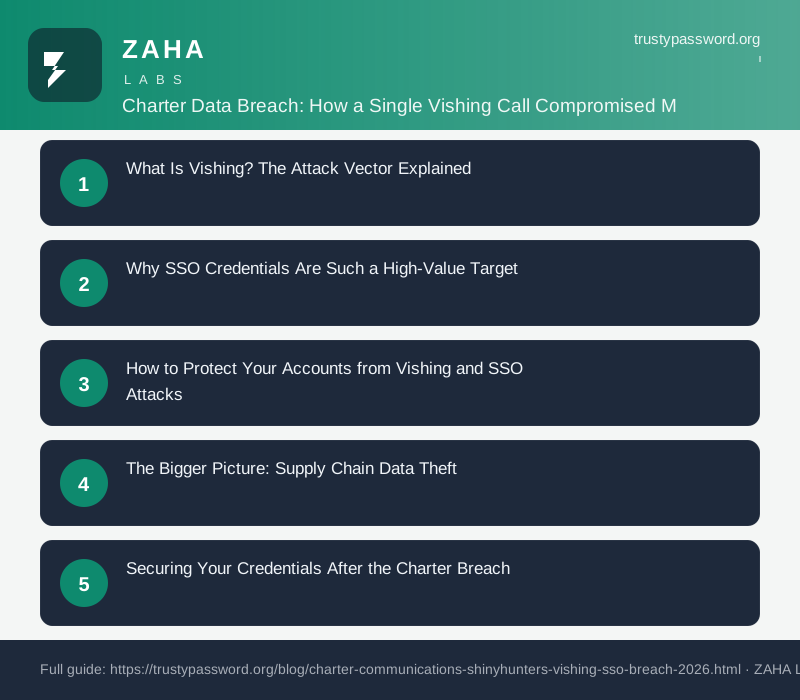
On this page
Charter Communications, one of the largest broadband providers in the United States serving tens of millions of customers through its Spectrum brand, has confirmed a data breach. The attackers? The notorious ShinyHunters extortion gang. The entry point? A single voice phishing (vishing) call that compromised an employee's Microsoft Entra single sign-on (SSO) account.
According to the threat actors speaking with BleepingComputer, the breach occurred on April 1 when attackers called a Charter employee and convinced them to hand over their credentials through a social engineering attack known as vishing. Once inside, the attackers used the compromised SSO session to export millions of customer records from Charter's Salesforce instance — including names, email addresses, phone numbers, physical addresses, and plan information.
The ShinyHunters group claims to have stolen 40 million records and listed Charter on their data leak site, threatening to publish the data unless a ransom is paid. While Charter maintains that "no sensitive personal information or customer proprietary network information was exfiltrated," the incident serves as a stark reminder that a single compromised credential can cascade into a catastrophic data breach affecting tens of millions of people.
This article breaks down how the vishing attack worked, why SSO credentials are such a high-value target, and what steps you can take right now to protect your accounts from similar attacks.
What Is Vishing? The Attack Vector Explained
Vishing — a portmanteau of "voice" and "phishing" — is a social engineering technique where attackers use phone calls to trick victims into revealing sensitive information. Unlike email phishing, which leaves a written trail and can be caught by spam filters, vishing exploits the trust inherent in voice communication.
In the Charter attack, ShinyHunters reportedly called an employee and impersonated a legitimate IT support or vendor representative. The attacker convinced the employee to provide their Microsoft Entra (formerly Azure AD) credentials, or to approve a multi-factor authentication prompt on their phone. Either way, the result was the same: the attacker gained authenticated access to the company's SSO portal.
The Anatomy of a Vishing Attack
Modern vishing attacks follow a predictable pattern that security researchers have documented extensively:
- Reconnaissance — The attacker researches the target company using LinkedIn, corporate websites, and data broker services. They identify employees in IT-adjacent roles who would reasonably receive calls about system access.
- Spoofing — Using VoIP services and caller ID spoofing, the attacker makes the call appear to come from an internal extension, a trusted vendor, or the company's IT helpdesk number.
- Social Engineering — The attacker creates a plausible scenario: a security update, a password reset, an MFA re-enrollment, or a vendor system migration. They use technical jargon and urgency to reduce the victim's skepticism.
- Credential Harvesting — The victim provides their password, approves an MFA push notification, or reads back a one-time code sent to their phone.
- Data Exfiltration — Once inside the SSO session, the attacker navigates to connected SaaS applications — Salesforce, Microsoft 365, Google Workspace — and begins exporting data.
This technique has been highly effective. Since 2025, ShinyHunters has used vishing-based credential theft to breach numerous organisations, including Instructure (the company behind Canvas LMS, affecting tens of millions of students), Snowflake customers, and multiple Salesforce integration partners. The FBI has issued multiple warnings about vishing attacks targeting corporate SSO accounts, and for good reason: it works.
Why SSO Credentials Are Such a High-Value Target
Single sign-on is designed to make authentication more convenient and secure. One set of credentials grants access to dozens of connected applications. But this convenience creates a single point of failure: compromise the SSO credential, and you compromise everything connected to it.
In the Charter breach, the attackers used a compromised Microsoft Entra account to access Salesforce. But with the same SSO session, they could have accessed Microsoft 365 email, SharePoint documents, Teams chat history, Azure cloud resources, and any other application federated through Entra ID.
The SSO architecture that organisations adopted to improve security has, paradoxically, become the most attractive target for attackers. The Verizon 2025 Data Breach Investigations Report found that 81% of hacking-related breaches involve stolen or weak credentials, and SSO credentials are the most valuable credential an attacker can steal.
The MFA Gap: Why Push Notifications Aren't Enough
Many organisations assume that multi-factor authentication protects against credential theft. But vishing attacks specifically target the weakest forms of MFA: push notifications and SMS codes.
Here is how MFA fatigue works in a vishing scenario:
- The attacker already has the victim's password (obtained through the vishing call)
- The attacker initiates a login attempt, which triggers an MFA push notification to the victim's phone
- The attacker, still on the phone, tells the victim they need to "approve a security verification" as part of the "IT maintenance" they claimed to be performing
- The tired, stressed, or distracted employee approves the notification
- The attacker is now fully authenticated with both password and MFA
This technique, known as MFA fatigue bombing, has been used in high-profile breaches including the Uber hack in 2022, the MGM Resorts ransomware attack in 2023, and now the Charter Communications breach in 2026. The only MFA method that resists this attack is FIDO2/WebAuthn hardware security keys, which require physical presence and cannot be approved remotely. CISA, the UK NCSC, and OWASP all recommend hardware security keys for SSO accounts protecting sensitive data.
How to Protect Your Accounts from Vishing and SSO Attacks
Whether you are an individual managing your own passwords or a business owner protecting your team, the Charter breach contains lessons that apply at every scale.
1. Use a Strong, Unique Password for Your Primary Email and SSO Accounts
Your email account and corporate SSO credentials are the master keys to your digital life. If an attacker compromises your primary email, they can reset passwords for every other service. If they compromise your SSO credentials, they can access every application connected to your identity provider.
Every SSO account should be protected by a cryptographically generated password — not something you made up yourself, but a machine-generated string drawn from the full character set. Tools like the password generator on TrustyPassword.org produce passwords with maximum entropy, ensuring that even if your password hash is exposed in a breach, it cannot be cracked in any practical timeframe. A password manager like NordPass makes it easy to generate, store, and autofill these strong unique passwords across all your accounts without ever needing to remember them.
For a comprehensive password generation and security assessment toolkit, BestPasswordGenerator.org offers strength checkers, entropy calculators, and credential security assessments that help you evaluate whether your current passwords are strong enough to resist modern cracking hardware.
2. Upgrade to Phishing-Resistant MFA
If you are still using SMS codes or push notifications for MFA on your email, SSO, or password manager accounts, you are vulnerable to vishing and MFA fatigue attacks. The solution is hardware security keys.
FIDO2 security keys (YubiKeys, Google Titan Keys, or similar) provide phishing-resistant authentication that cannot be bypassed through social engineering. Even if an attacker has your password, they cannot authenticate without physical possession of the key. CISA's guidance explicitly recommends FIDO2 hardware keys for administrative accounts and any account with access to sensitive data.
For organisations, Microsoft Entra ID supports FIDO2 authentication natively. Enforcing FIDO2-only MFA for privileged roles eliminates the vishing attack vector entirely.
3. Encrypt Your Internet Connection
Even strong credentials can be intercepted if transmitted over an unsecured network. Vishing attackers often work in combination with network-level attacks — they may compromise an employee's credentials through vishing, but they also exploit unencrypted traffic on public Wi-Fi to intercept session tokens.
A reliable VPN encrypts all your internet traffic, preventing session hijacking and credential interception on untrusted networks. For comprehensive protection, Hide My Name VPN provides military-grade encryption with a strict no-logs policy, ensuring your SSO sessions remain private even on compromised networks.
4. Deploy Endpoint Protection That Detects Credential Theft
Modern endpoint protection platforms can detect the behavioural patterns associated with SSO credential theft — unusual login locations, impossible travel times, bulk data exports from SaaS applications, and suspicious API calls.
An enterprise-grade security suite like Kaspersky Premium includes real-time threat monitoring, behavioural analysis, and identity protection features that detect when credentials are being used in ways that deviate from normal patterns.
5. Use Encrypted Email for Account Recovery
Your email account is the ultimate backstop for password resets and account recovery. If an attacker compromises your email, they can silently reset passwords for every service you use, including your SSO provider.
For sensitive communications and account recovery, end-to-end encrypted email ensures that even if a service provider is compromised, your password reset links and recovery codes remain unreadable. Trekmail provides zero-access encryption for all email communications, keeping account recovery links and sensitive messages private from the provider itself.
6. Secure Remote Access with VPN for All External Connections
The Charter breach demonstrated that remote employees connecting from external networks are particularly vulnerable. Organisations should require VPN connections for all external access to corporate resources.
For remote workers and travellers, Turbo VPN provides high-speed encrypted tunnelling with a no-logs policy, ensuring that SSO sessions initiated from coffee shops, hotels, and co-working spaces are protected from network-level interception.
The Bigger Picture: Supply Chain Data Theft
The Charter breach is part of a broader pattern of supply chain data theft that has escalated dramatically in 2026. ShinyHunters specifically targets organisations that act as data aggregators — Salesforce instances containing customer data, education platforms holding student records, and telecommunications companies with subscriber databases.
Charter Communications stores data from tens of millions of residential and business customers. A single compromised SSO account at Charter exposed data that affects more people than many nation-state data breaches. The attackers didn't need to breach Charter's core network — they just needed one employee's credentials to access the Salesforce instance where all that data lived.
This is why credential security matters at every level. The weakest password in your organisation determines your breach risk. A help desk employee's vishable credential can expose the same data as a CISO's hardened account — because SSO treats all authenticated sessions equally once the user is inside.
FAQs
What is vishing?
Vishing (voice phishing) is a social engineering attack where criminals use phone calls to trick victims into revealing sensitive information, such as passwords, MFA codes, or financial details. In the Charter Communications breach, attackers used a vishing call to compromise an employee's Microsoft Entra SSO credentials.
How did ShinyHunters breach Charter Communications?
According to the threat actors, they called a Charter employee on April 1, 2026, and used voice phishing to obtain their Microsoft Entra credentials. With access to the employee's SSO account, they then exported millions of customer records from Charter's Salesforce instance.
How many records were stolen in the Charter breach?
ShinyHunters claims to have stolen 40 million records containing personal information of Charter customers. Charter has confirmed a data breach but states that no "sensitive personal information" or "customer proprietary network information" was taken.
Can MFA prevent vishing attacks?
Standard MFA methods (SMS codes, push notifications) can be bypassed through vishing — attackers convince victims to approve MFA prompts during the phone call. Only FIDO2 hardware security keys provide phishing-resistant authentication that cannot be socially engineered.
What is the best way to protect an SSO account?
The strongest protection combines a cryptographically generated unique password, a FIDO2 hardware security key for MFA, VPN encryption for all network traffic, and endpoint security that detects anomalous credential usage.
How can I check if my data was exposed in the Charter breach?
Monitor Have I Been Pwned (haveibeenpwned.com) for Charter-related breach notifications. If you are a Charter customer, consider placing a fraud alert on your credit file.
What is the difference between vishing and traditional phishing?
Traditional phishing uses email or text messages to lure victims to fake websites. Vishing uses phone calls, exploiting the trust inherent in voice communication. Vishing is harder to detect because there is no written message for spam filters to analyse.
Securing Your Credentials After the Charter Breach
The Charter Communications data breach is not an isolated incident — it is a warning about the evolving nature of credential attacks. Attackers are no longer just stealing password databases from poorly secured servers. They are calling employees directly, manipulating them into handing over access, and then using that access to exfiltrate data at industrial scale.
The defence against this threat requires a layered approach:
- Cryptographically generated, unique passwords for every account, managed through a password manager
- FIDO2 hardware security keys for MFA on all critical accounts
- VPN encryption for all internet traffic, especially when working remotely
- Endpoint security with behavioural detection for anomalous credential usage
- Regular security awareness training that includes vishing-specific scenarios
Start by auditing your own credential security. The password generator and strength checker on BestPasswordGenerator.org can help you evaluate whether your current passwords are strong enough to resist both remote cracking and the kind of targeted credential theft that brought Charter Communications to its knees.